WordPress core
Security releases promptlySmall point releases mostly patch security issues and go in quickly. Major versions wait until we have confirmed your forms, booking tools or shop still behave with them.

Website Maintenance
Website maintenance for Brantford, Ontario businesses: updates, backups and security checks, plus the seasonal hours, festival weekends and closure notices that keep a site truthful.

Two cases from the suggestion data show why website maintenance matters, especially for local facts. Conestoga College announced in April 2025 that its Colborne Street location in Brantford would close, with programs moving out by that September, yet in October 2026 Google still suggests “conestoga brantford campus” and “conestoga brantford residence”. And although the Brant County Health Unit merged with Haldimand-Norfolk to form Grand Erie Public Health on 1 January 2025, “brant county health unit” still appears among the suggestions. Facts change, but pages left alone do not.
Your own site, meanwhile, faces the same drift on a smaller scale. Brantford’s year has a clear shape: snow from about October to April, the Chili Willy Cook-Off in February, the International Villages Festival in July, Kinsmen Ribfest in August, then the Christmas market and parade. Shops change hours, trades switch from lawns to snow, restaurants open patios and close them again. People check, too, with searches such as “brantford farmers market christmas hours” and “lynden park mall hours”. A home page still pushing summer specials in December tells visitors nobody is watching.
Still, some changes cannot wait for a calendar. Searches such as “brantford colborne street closed”, “highway 403 brantford closure” and “brantford west brant power outage” show people looking up disruptions as they unfold. If a road closure, an outage or a storm alters your hours, a short notice on your site the same day, matched on your Google listing, spares customers a wasted trip.
Search demand
Google.ca suggestions from 5 October 2026. Not one mentions website maintenance, but every one asks for information with a shelf life.
Brantford businesses already plan around the seasons, so the website can follow suit. Therefore we agree the dates with you once a year, first snow, spring thaw, summer festivals and the Christmas market and holidays, and prepare the page changes ahead of each. Alongside that schedule, we also run a same-day notice routine for closures, outages and weather.
Silent problems
Nothing flashes red when these happen; instead, inquiries just quietly dry up.
For example, a patio promotion in November or a spring clean-up offer in February signals that nobody is minding the site. It can also contradict your Google listing, and then customers believe neither.
The visitor sees a polite thank-you, so no one complains, but the message never reaches your inbox. That is because mail sent straight from the web server often lands in spam or bounces. Routing it through an authenticated mail service, then testing monthly, solves it.
Pages that still send readers to the Brant County Health Unit, a retired bus route or a partner that has relocated look neglected and frustrate visitors. So a yearly link check catches most of them.
If you ask who controls the web address and the hosting, many owners are unsure. It may sit with a former designer or under a past employee’s email. So we record every account and renewal date, then bring control back into your company’s name.
Attackers scan for plugins that no longer receive security fixes. Once in, they often add hidden pages selling unrelated goods, absent from your menus but visible to Google. Strange results when you search your own business name are usually the first clue.
The moving parts
A WordPress site is assembled from parts made by different people, so each needs its own kind of care.
Small point releases mostly patch security issues and go in quickly. Major versions wait until we have confirmed your forms, booking tools or shop still behave with them.
In fact, plugins cause most problems on small sites. We keep the list short, remove anything unused and update the rest one at a time, so any fault can be traced to its source.
Also, PHP, the language your site runs on, has its own end-of-support dates. We test on the newer version first and schedule the switch, instead of waiting for the host to force it.
A lapsed domain or certificate means a browser warning or a blank page, and email can fail with it. So we keep renewal dates and account owners together in one place.
The work
Every update starts with a complete snapshot of the site. As soon as it finishes, we load your key pages, such as home, contact, bookings or checkout, on a phone and click through them.
Copies taken daily or weekly to match how often the site changes, kept with a provider other than your host, plus a test restore now and then to prove they work.
Old staff logins removed, two-factor sign-in switched on where possible, regular malware scans, and prompt patches whenever a flaw is announced in something you run.
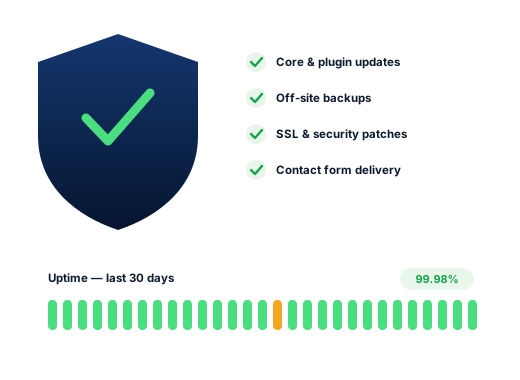
An outside monitor pings the site day and night, so if it goes offline, an alert reaches us within minutes.
We fill in every contact and booking form ourselves and confirm the message arrived, because a broken form looks normal from the outside.
Winter hours, a spring service list, a festival weekend or a closure notice: send the details and it goes up, then comes down once it no longer applies.
Done carefully
The rules we follow on every account, written down so you can hold us to them.
Maintenance should never turn into leverage. The main accounts stay in your name; ours is a guest login you can remove at any time.
Routine website maintenance comes with the monthly plan, but rescue work is separate. A site years behind on updates, or one already infected, needs a one-time clean-up that is quoted and agreed before we start.
Ask us about your business
How we work
From the first audit through to a monthly report written in plain language.
We review your website and Business Profile, then search from several parts of Brantford to see where you show up today.
We shortlist the searches that tend to end in a booking or a quote and give each its own page.
Profile, website and content changes, starting with the ones expected to move results first.
One page each month about enquiries, rankings and the jobs we have lined up for next.
Questions
No, because patches and updates come with every plan: Starter ($250), Growth ($350) or Pro ($550) monthly, charged in CAD without a lengthy contract. We quote a one-off fee only if a site reaches us badly out of date or already hacked.
As soon as you send the details, we aim to publish it the same day. We will also remind you to update the hours on your Google Business Profile, which many people check before they ever open your website.
Yes. Tell us when you move from lawn work to plowing, or when holiday hours begin, and the revised pages are drafted early and published on the agreed morning.
Taking stock. We list the theme and every plugin, flag what has fallen behind, and find out whose accounts hold the domain, the hosting and the mailboxes. That then tells us which fixes come first and lets us price the catch-up honestly.
Very possibly. The clean-up is billed once: we find and remove the injected code, close the weakness that let it in, reset every login, and, if Google or browsers are warning visitors, request a review once the site is clean.
No. You buy hosting in your own name from a provider, so the site never depends on us to stay online. However, we can recommend suitable hosts and manage the move for you.
Further reading
Related reading for Brantford, Ontario owners on this topic.
Any of these can be hired separately; most clients start with one.
Each trade is searched differently, so every page here rests on its own keyword research.
A free look at where you rank from West Brant to Eagle Place, who sits above you and what to fix first.
Request my free audit